
|
|
| Home Previous Next | |
|
|
Balloons and ShipsSaturday, 13 January 2001It has been a most exciting week here in Antarctica. The Long Duration Balloon (LDB ) program was finally able to launch the second and last balloon of this season. The payload on this balloon is called Top Hat and is based primarily from the University of Chicago. Their objective is to measure Cosmic Microwave Background Radiation. The really interesting part of this balloon mission is that they have a huge payload that hangs from the balloon like all the other missions, but they also have a telescope that sits on top of the balloon. To the best of my knowledge, this is the first time any part of a payload has ridden on top of a balloon. By measuring the Cosmic Microwave Background Radiation (CMBR), the Top Hat team expects to be able to calculate all of the mass and energy of the universe. From this they will be able to learn the age of the universe and gather much information relating to the Big Bang. They should be able to learn how fast the universe is expanding, and hopefully tell whether it will expand forever or eventually begin to collapse back into itself. The telescope sitting on top of the balloon will be constantly spinning, which will allow them to get a complete image of the sky above the Southern Polar Cap each day. The weather has not been very good for flying balloons. The winds have to be less than seven knots, not only on the surface but for quite some ways up as well. Before Christmas the weather had been perfect for several weeks, but none of the science teams were ready to go. Just a few days before Christmas the weather began looking bad. We had a small window of calm weather on the 28th and that is when they launched the first balloon. After that, the weather has again been bad and forecasters said they expected the bad weather to continue until mid January. Waiting that long could present big problems as it takes the balloon 10–14 days to circumnavigate the continent. Once it lands there has to be time to send airplanes or helicopters out to recover the payloads, which also hinges on the weather. The beginning of February is when people start leaving the Ice, so planes are very tied up then. Last year's payload was so late and the weather was so bad that they were unable to recover it, and had to recover it this year. Considering all that, everyone wanted to hurry and get this last balloon in the air. Finally the weather folks said that on January 4 looked like there might be a small window of opportunity. They sat up all night watching the weather and sending up small test balloons, and then they scheduled the launch for around 11:00 A.M. As the day progressed and weather patterns changed, the launch kept getting pushed further and further back. Finally in the mid afternoon they started laying out the balloon and its payloads. 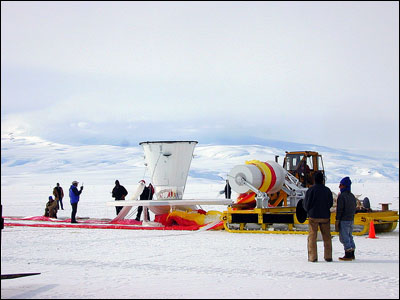
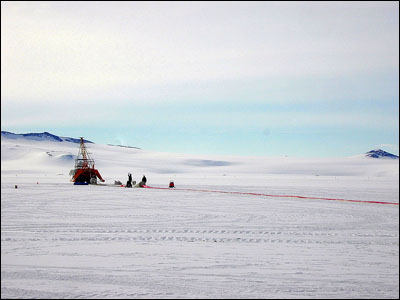
The telescope weighs approximately 550 pounds. Getting it to sit on top of a balloon was no easy feat, although from my vantage point on the sidelines they looked very well rehearsed and in control. They attached the telescope to the top of the primary balloon, and then inflated a smaller balloon to support the telescope while the primary balloon was being inflated. 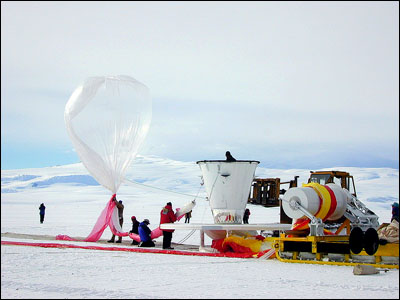
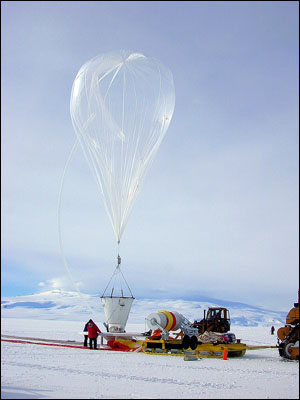
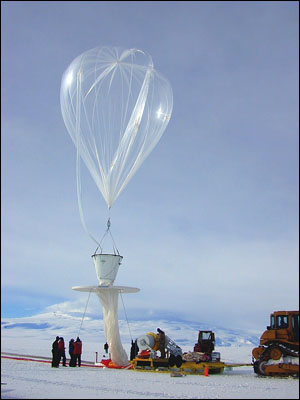
Then they began inflating the large balloon. That process takes around an hour or two. 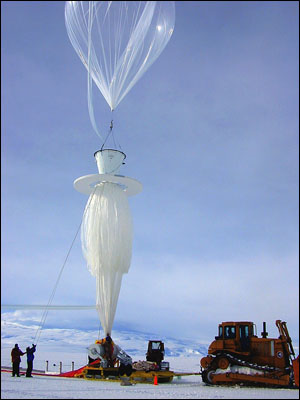
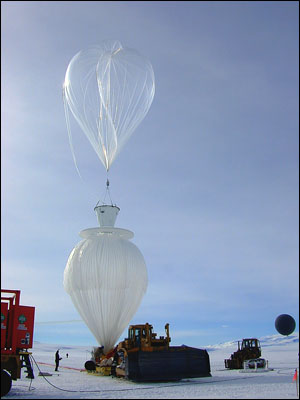
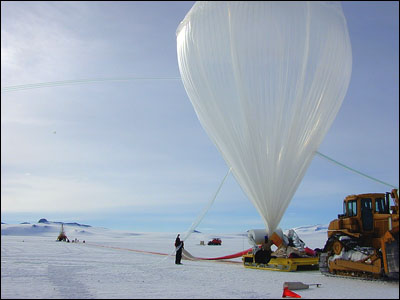
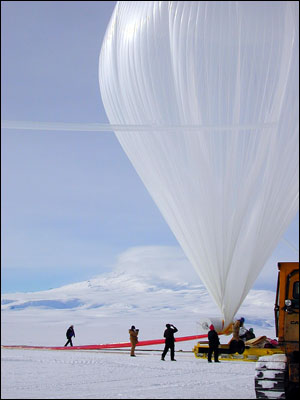
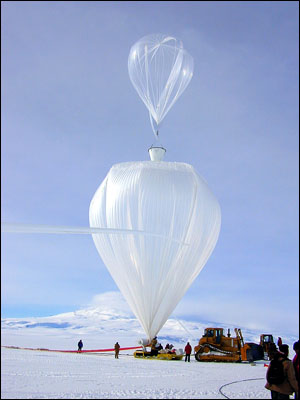
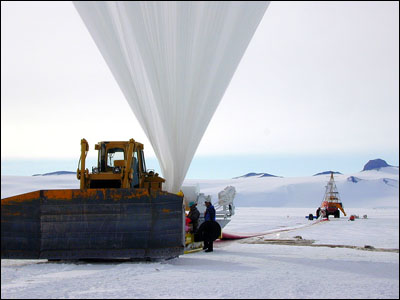
Once the primary balloon had enough helium in it, they released the small balloon and let it fly away. 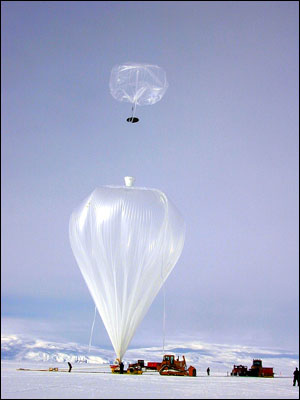
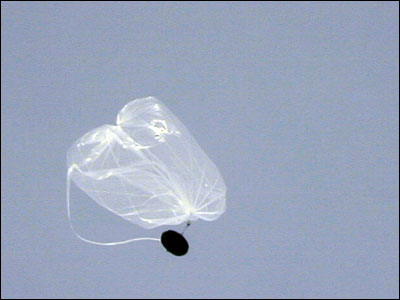
The telescope is now resting entirely on top of the big balloon. 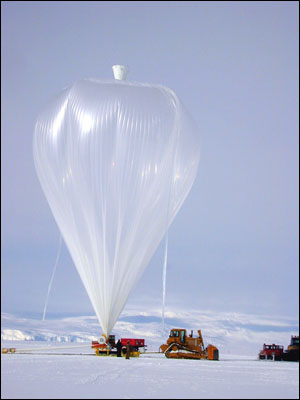
They had to wait for an airplane to land before they could launch the balloon. The winds had changed direction from the time that they first laid out the balloon, so instead of the balloon lifting up over the bottom payload, the payload was going to have to come to the balloon. It hangs on a launch vehicle that can move once the balloon is up out of the way. 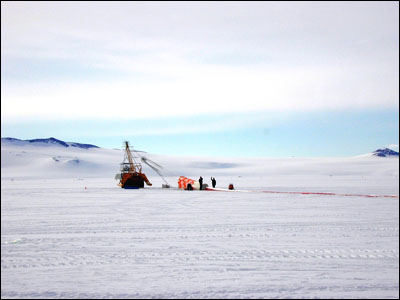
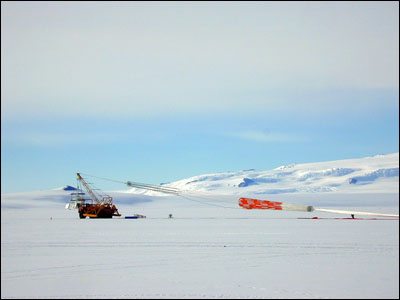
Finally they released the balloon and up it went, pulling away from the payload instead of toward it. 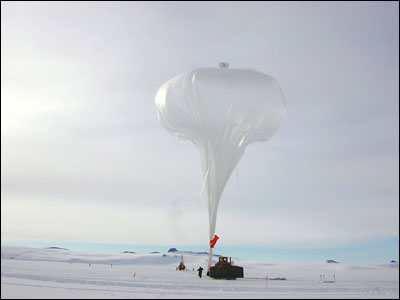
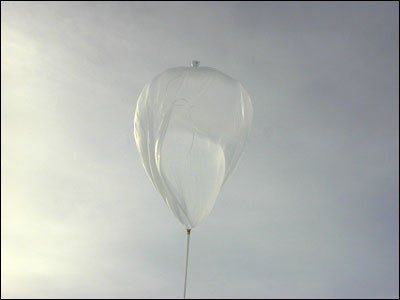
The launch vehicle took off following the balloon with the payload swinging wildly in front. 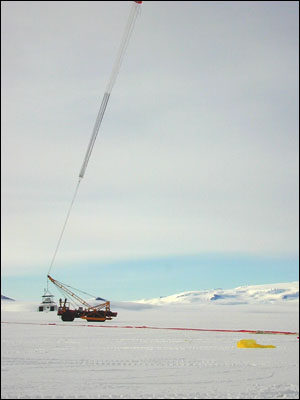
After a few minutes they were lined up under the balloon and could release the payload. 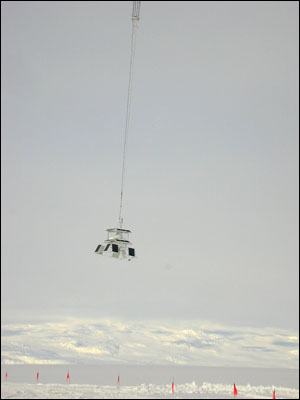
The entire package started flying up. 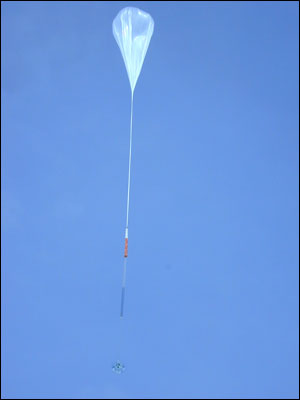
It was just after 8:00 P.M. The sky had almost totally cleared so the balloon was visible most of the night. Even when it reaches an altitude of approximately 125,000 feet, it is still visible from the ground, which should give you some idea of how huge it is. I am told that it ends up being about 500 feet in diameter once it reaches altitude. After all these months the end of the season is almost here. The Polar Sea, the Coast Guard icebreaker, has arrived. It has been working for the last few days cutting up the ice out in McMurdo Sound. Finally they have cut a channel all the way to the ice pier in town. It will not be too long before all that chopped ice gets blown out to sea and we will have open water off of our shore line. Places we used to ride to in vehicles and places where airplanes landed just a month ago, will soon be open water. It is interesting that just after they cut a channel through the ice, the seals pop out and begin sunning themselves on the surface. Looking across the sound today, I must have counted at least 60. 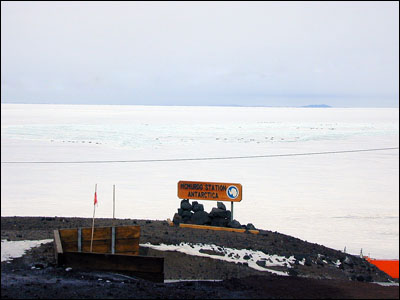
The ship was late arriving this year because the ice has been difficult to break through. The condition of the ice at the moment is called rubber ice," which means that the ice is soft and difficult to break. The ship rides up onto the ice, but it does not break through, it just stretches. It has only been moving about ½ mile per hour, about an eighth of its normal speed when breaking ice. 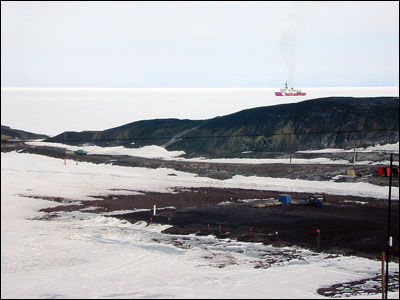
The Polar Sea is the sister ship to the Polar Star that was down here last season. Besides breaking ice, there are several science labs on board studying marine and climate science. On Route to McMurdo they delivered several automated weather stations around Antarctica. This year they also have a film crew on board to film the giant icebergs off Ross Island. 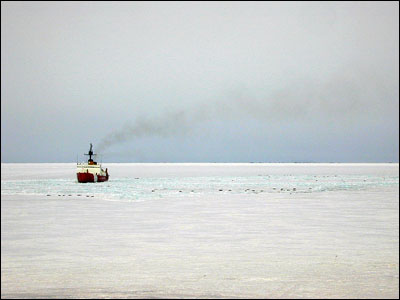
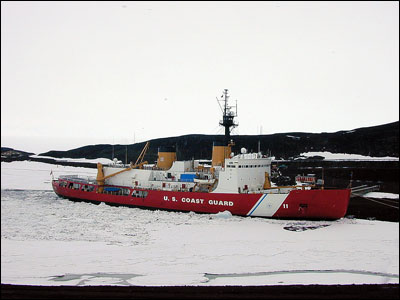
After a good channel is cut, we will be expecting a fuel tanker and then a supply vessel, and also a few cruise ships. Before leaving this area in February, the Polar Sea will be host to a "morale cruise" for the entire station of McMurdo. It is generally offered over two days so that half the town can go one day and the other half the next. I went on one last season and it was amazing. We saw seals, and penguins and whales galore. We also saw beautiful icebergs and such. I am looking forward to going again. |
|
| Home Previous Next | |
|
|

|
|
|
|
|
Irma Hale McMurdo Station, Antarctica E-mail: Copyright © Irma Hale. All
Rights Reserved. Free counters provided by Vendio. |
|
|



