
|
|
| Home Previous Next | |
|
|
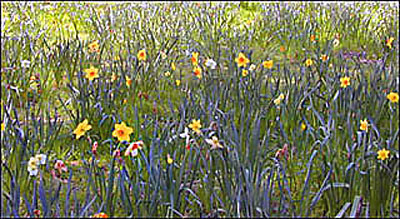
Travel to AntarcticaSunday, 3 September 2000It seems I am living in eternal summer. I spent last summer in Antarctica, returned to Florida for the summer and now I'm back in Antarctica for yet another summer — all in a year and a half. But summer is hardly what it feels like when I put on 3–4 layers of clothing just to walk between my dormitory and the galley, layers which include expedition weight long underwear, a fleece layer, a wind layer and finally a very thick down parka. I left home 20 August and flew to Denver where I visited a friend whom I worked with in Antarctica last season. The next day I went to orientation. They briefed us again on various aspects of Antarctica with a big emphasis on safety. Antarctica is a very harsh continent with many dangerous situations which can easily become life–threatening without the proper education and preparation. We are given many lectures and briefings on what to do and how to respond. We have a new employer this year, Raytheon Polar Services, and much of our orientation time was given to discussing the differences that will be in effect from last season. Later that afternoon we caught a plane to Los Angeles and then another to Auckland, New Zealand. I used my frequent flier miles to upgrade my ticket and I am very glad I did. It made all the difference in that 12½ hour flight. Unlike many of my co–workers, I arrived in Auckland rather well –rested and happy. We then caught yet another flight to Christchurch, New Zealand and finally checked in to our hotel. So far we had spent 21 hours in the air and were not done yet. Christchurch is our last stop before heading to The Ice," as we all fondly call the southern–most continent. It is here that we are issued our Extreme Cold Weather gear (referred to by most as ECW gear). We are issued about 50 pounds of clothing including boots, all of which is designed to be life–saving if you are ever caught in a storm, or get trapped in the ice. I was scheduled to get my ECW gear the morning after my arrival, and then to fly to the Ice the following morning. I spent the afternoon walking around Christchurch and doing some last–minute shopping. When I got back to my hotel that evening there was a notice posted that our flight had been postponed for 24 hours due to a bad storm down on the Ice. The next day (Friday) I went for a long walk in the Botanical Gardens. Christchurch has one of the largest, most beautiful, botanical gardens I have ever been to. I also went to the Arts Center and caught a movie. 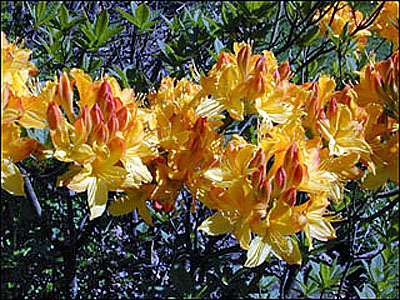
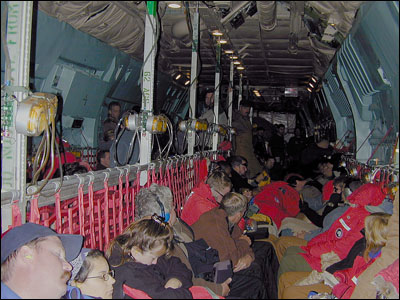
As we were due to leave very early the next morning, I went home and went to bed. I got up at 1:30 A.M. and dressed and packed my gear. The shuttle was to pick us up at 2:00 A.M. I got downstairs only to be told that our flight had just been canceled again. As I was already wide awake, I stayed up and read for several hours before falling asleep for a couple of hours more. Saturday it rained all day. I went for a nice brunch with some friends and caught a little of the art show, then went to another movie and got home to bed early. Finally on Sunday everything was a "go." On the day we are due to fly we have to check in at the Antarctic Center by 2:45 in the morning. We have to dress in our full ECW gear, finish packing the remaining gear, and get all of our luggage checked in. After all of that we are free to grab a bite to eat or a nap. At 4:30 we have to report back and are lectured about safety on board the aircraft, an Air National Guard C–141. Then we are shown a video describing hypothermia, frostbite and other things to watch out for. We begin the boarding process around 5:00 and finally take off at 6:00. The flight is 5½ hours long. The reason that all of this has to be so early is that the flight crew will have to return to Christchurch the same day after unloading us and the cargo and reloading another group and another load of cargo. The C–141 aircraft has no windows. There are two aisles running the length of the plane and we sit on either side of those aisles facing one another. Our knees touch the person's across from us. There is not much room and it is not very comfortable. If anyone has to get up to use the facilities (which are also rather primitive) you literally have to crawl over one another to get there. Most of us read or slept. We are all given a packed lunch consisting of two sandwiches, chips, cookies, fruit, candy bars, water, and juice. It seems a little excessive for a 5½ hour flight, but on very rare occasions planes have had to make emergency landings. Last season it was three days before a rescue could be made. Given those circumstances it doesn't seem like much food. 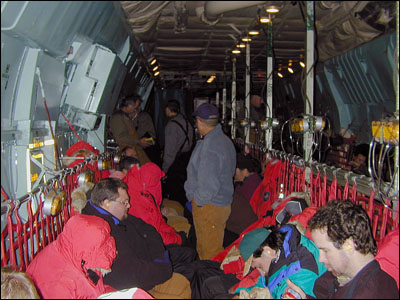
At one point in the flight I had to make my way to the front and use the facilities. I stayed up there and stretched for a while and struck up a conversation with some of the Air National Guard flight crew. They took me up in the cockpit so that I could see out. It was really beautiful. The weather was very clear. I could see the pack ice below and enormous icebergs — bigger than whole cities. It was amazing. I stayed up there for about 20 minutes. Just before I returned to my seat we could see one of the islands just north of the continent. We made a beautiful landing just before noon at the Pegasus Runway on the permanent sea ice about 15 miles outside of McMurdo Station. 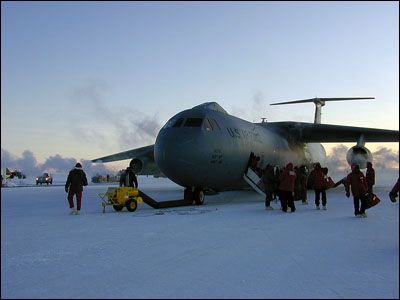
The weather was exquisite. The temperature was only about –20°F, but there was very little wind so it didn't feel bad at all. Although it was midday, the sun was very low in the sky and all the mountains had a beautiful rosy glow on them. 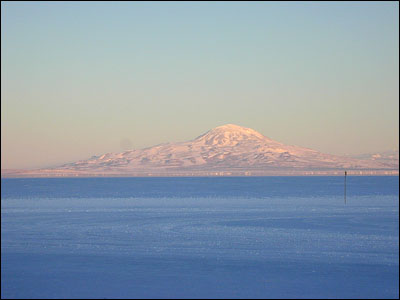
The really strange thing for me this season is the darkness. Last summer the sun was up 24 hours a day and I got quite accustomed to coming home late in the evening in full sunlight. So to see sunsets and then darkness is amazing to me. And the stars at night are very beautiful. 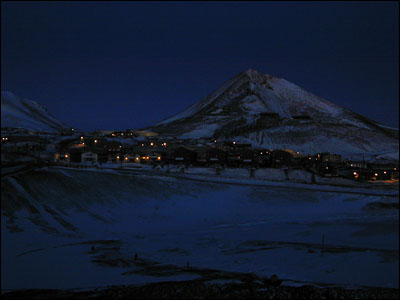
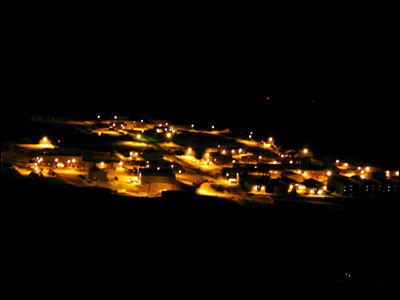
I have been hiking every day since I arrived. It has been cold enough to freeze the hair on my face, but we haven't had a lot of wind, so hiking has been quite pleasant. We even went hiking late one evening to look at the stars. We saw just a hint of the southern lights, but it wasn't much to see. Still, having never seen anything like it before, I was quite excited to see them. 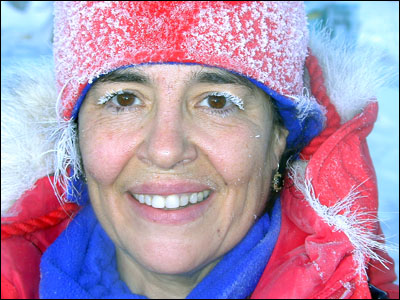
Because of the tilt of the earth's axis relative to its orbit around the sun, the sun does not shine at the South Pole for 6 months of the year. At McMurdo Station the first sunrise was only just a week ago. Of course each day is considerably longer than the one before. On Monday the faint glow of light in the morning sky did not begin until around 8:30 A.M. By Wednesday it was already visible at 7:30. Sunrise on Wednesday was at 9:43 and on Thursday at 9:34. Things change very quickly this time of year. 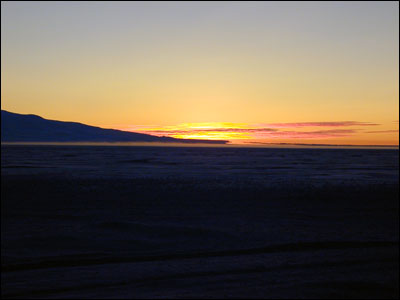
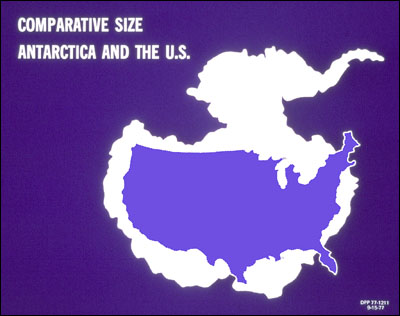
Antarctica has some of the most extreme conditions to be found anywhere on the earth. It is the highest, driest, windiest and coldest continent on earth.
Highest: 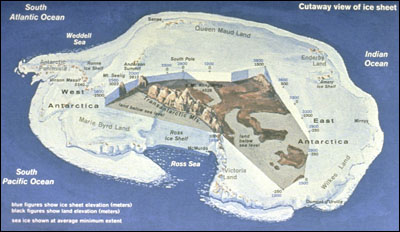
Driest:
Windiest:
Coldest: In an Antarctic blizzard, very little, if any, snow actually falls. Instead, the snow is picked up and blown along the surface by the wind, resulting in blinding conditions. Visibility can easily drop to less than a meter. A whiteout is a peculiar condition caused by a combination of snow and clouds. Even though the air is clear, when the sky is overcast there are no shadows or contrasts between objects, nor is there a horizon. A uniformly grey or white sky over a snow–covered surface causes a loss of depth perception — it is impossible to judge height or distance. Walkers will stumble and even birds will crash into the snow. 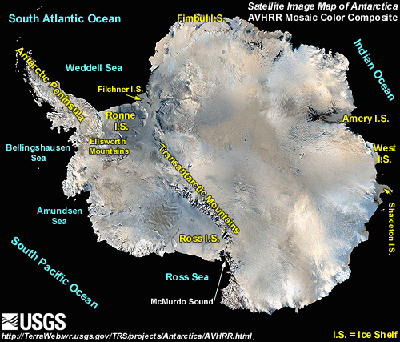
|
|
| Home Previous Next | |
|
|

|
|
|
|
|
Irma Hale McMurdo Station, Antarctica E-mail: Copyright © Irma Hale. All
Rights Reserved. Free counters provided by Vendio. |
|
|



